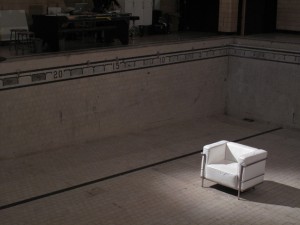
L’artiste invite le public assis sur le pourtour de la piscine à venir prendre place dans le bain où il se tient lui-même en complet chic, dans une attente digne sans être cérémoniale. Derrière lui, dissimulé sous une épaisse couverture, un fauteuil de cuir blanc chromé … Florian attend patiemment que les gens s’installent. Le tempo est donné : l’allure sera davantage largo qu’allegro.
- Prologue for 300
And so as people start slowly filling up the basin of the pool at his request, his stance is somewhat like a patient professor in this formal attire waiting for his students to switch places and settle down.
This is the beginning of a new series called “Prologue for 300” – a set of actions within an already existing series of video performances called “300.” This evening he presents five, 300-second gestures – “relational works” he tells us as he presents his introduction. And I wonder “relational to what?” We’ve come to understand relational work to be work that involves a social interaction between people – either between the artist and audience/participant, or between audience/participants engaging with each other, to activate the work. In this case the relationship seems to be between the artist and the chair, a high-modern Le Corbusier (Bauhaus) design.
In fact the minimalism inherent in his performance space (simply the artist and a chair) is a key component in the work he is presenting. Seemingly simple actions belie a complexity of performative registers; a collection of gestures pared down and infused with unnamed potential – the way in which Le Corbusier imagined a body and a chair could relate?
As these short stringed-together pieces will eventually become part of his larger video series, before officially beginning each action, Florian does a quick ‘stage-blocking’ test. His Berlin colleague (Jörn J. Burmester) sits inconspicuously on the floor at a respectable distance adjusting the camera angle then gives him the OK. Florian then takes the timer in his hand, extends his arm out to the audience for everyone to verify (yes, each of the five actions will be timed), sets it at 300 seconds and commences.
A Man, A Suit, A Chair
No. 1:
Lying belly to the floor, palms and soles of his feet facing upward, head tilted to the side with the frames of his glasses and right cheek touching the cold tile. Stretched out horizontally in front of the chair but perpendicular to it. We watch him listening to the ground, taking the pulse of the pool. Is his heart beating with the floor? What exactly is he in relation to now? The floor? The chair? His heartbeat? His Suit? His cheek on the cold yellowing tiles? Is he daydreaming about being in the chair where he is not? Or perhaps he is dreaming of being the chair, the object that he can’t really ever be.
300 seconds becomes time out of time, he has expanded the moment into a small infinite that could go on eternally. The longer I sit and stare at him lying in front of the chair the more he becomes a near facsimile of it; a momentary flicker of their collusion emerges: a suited brilliantly gleaming white leather man and chrome contoured seat.
The buzzer sounds.
No. 2: “I wonder what he’s doing with his hand.” Anne says this to me and I realize that I’m not exactly thinking the same thing. With his back to the audience, neck in a slight and slightly awkward arc, having unzipped his pants and placed his right arm down the front of his slacks, I can’t see his hand either – but I assume the worst. Standing next to and a little behind the chair, this pose is simultaneously tense and relaxed – and kind of contrived. It actually makes me think of a 1950s Sears catalogue, a sporting lad’s tableau vivant depicting the golfer, having just hit a putt and craning to see where the ball may have landed. It pleases me to not see his hand but to imagine what his hand must be seeing and feeling.
No. 3: A removal of clothing, he becomes ever slightly more vulnerable: now the jacket comes off entirely and the pants are dropped to the floor. Crouching on all fours at a front corner of the chair. White jockey-style underwear – a businessman in dissolution. He and the chair cast competing and parallel shadows on the floor, their para-presences in confluence and communicating a distant dance. Is he beholden?
No. 4: This action, Florian tells us, is from a sub-series of his series called “Licked Pieces.” A slow procession with tongue outstretched along the smooth edge of the metal bar that surrounds the chair. His tongue leads his body around the counter of the chair and again he denies us of sight (and site?) when, once squarely behind the chair we no longer are privy to his action. Only to our imagination. Gradually the tongue leads his body to the floor, the chrome bar descending and a slither of his tall, lank frame once again pressed (but in motion) against the tiles.
No. 5: This action is separately titled as well, Florian informs us: it is called: “Exercises in Levitation.” In a sense it is the culmination of the previous gestures as Florian finally makes contact – and at once begins to show signs of physical duress. The armrests become his supports as he lets the full weight of this body sink down into what must be their quite uncomfortably angular edges (remember: we’re talking minimalist Bauhaus here). It’s the first action revisited, this conclusion, except now he finally is the chair, stretched out and flipped (on his back), hanging with his head precariously balanced over the side.
Endings and In-Betweens
I think it’s worth noting the significance of each action’s end, and the weight of time and space between one action to the next. For while each one is discreet, there is a thread that carries him – not just the sameness of the chair but the attitude he brings to his rapport with it. Actually, it’s more than a dialogue with the object, it is his dialogue with the space and this comes through probably the most in the moments when Florian is between actions or is completing a gesture; a savoured moment with absolutely no sense of urgency. A meticulous consideration of the space he is in. How is it different now than it was 300 seconds ago? How is he transformed? At moments this is a question I find myself asking when watching any performance. However in the case of Florian’s work, it is a state that I am actively observing.
Perhaps this is what Le Corbusier had in mind when he began to design furniture: how does this object, meant to hold a body, also hold a space? How does it respond to a body? Florian becomes a conduit for this contemplation and makes us aware through simple, graceful – and streamlined means – of a daily relationship we all know inherently, but often in mostly unconscious ways.

