8 octobre
Last Days of Snow: the begending of the universe is a thoughtful presentation about technological advancement; about the evolution of television and the end of the analogue broadcast – really, about the end of an era. This is a recent preoccupation of Amanda’s and she has spent a significant amount of time developing a personalized (read: artistic) understanding of intricate scientific equations that surround this technology. Approaching her material not as a scientist but as an artist, she has been creatively analyzing such “facts,” applying an interdisciplinary mode to her artistic research.
Amanda Dawn Christie
And so as an artist working with scientists (being in regular contact with an astrophysicist, a specialist of quantum mechanics and a retired employee of a nuclear power plant), one impetus for this work came from a statement that one of her collaborators made: “Snow on TV is leftover radiation from the Big Bang.”
Such a statement sparked an enormous curiosity, causing her to publicly contemplate this phenomenon through her performance: the opening line of her piece being “I don’t know if I believe this or not.” (The first line of the text that Amanda states is, actually, more specifically related to the first equation she displays on the wall during her piece – a formulation of the Heisenberg Uncertainty Principle.)
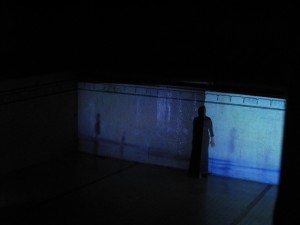
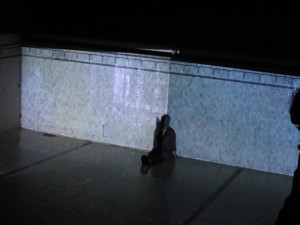
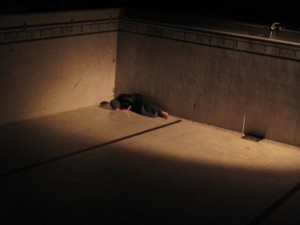
With projected video, a beautiful calming waterfall (on the back wall of the pool), and a subdued yet striking costume (covered head to toe in grey, including a cloth covering Amanda’s entire head and face), the performance is rich in imagery. However, after hearing her passionately describe her process during an excellent discussion in a Performer Stammtisch session, it occured to me that the foundation of her piece, its heart and its very performativity, resides in its preparation and research. Her ongoing dialogue with the scientists, a back-and-forth exploration recorded meticulously in colour-coded diagrammatic pages creates an effervescent record of her work-in-process.
Amanda Dawn Christie
It is important to mention the role of the voice in this process too. In her quest to memorize the many long and arduous temperature measurements that she recites, she used song as a mnemonic device to be able to accurately generate these lengthy mathematical statements. The result is a litany of numbers that at once overwhelm and pique our curiosity.
I can quite imagine this work continuing to be developed in the form of an opera – and the way in which Amanda describes its potential development (wishing to explore the lives of those physicists who devised our modern systems for measuring temperatures) sounds as though it could really lend itself to such a rendering. Perhaps this eventual performance (which I really hope she pursues) can somehow integrate the overlapping dialogues, in order to demonstrate a form of performativity related to the interdisciplinary researcher. This kind of investigation, inherent in both the larger fields of Science and the Arts, would surely contribute towards opening up a fresh perspective (replete with possibilities and potential) for both.
Amanda Dawn Christie

